
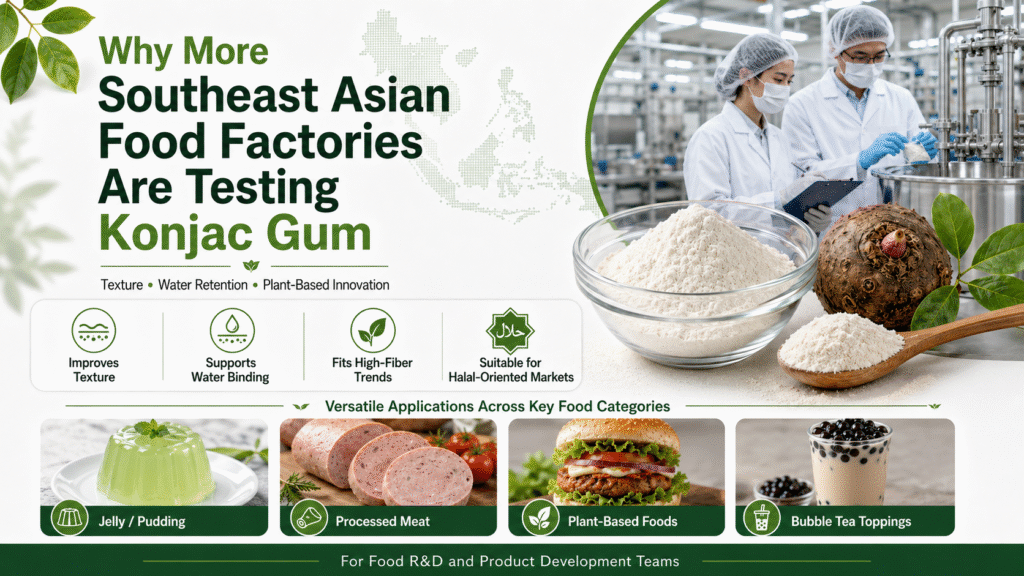
Why More Southeast Asian Food Factories Are Testing Konjac Gum in New Product Development
In recent years, more food manufacturers in Southeast Asia have started paying attention to functional ingredients that can improve texture, stability and product value without making formulas too complicated.
One ingredient that is receiving more interest is konjac gum.
Konjac gum, also known as konjac glucomannan, is a plant-based hydrocolloid extracted from konjac root. It is widely used as a thickener, stabilizer, gelling aid and texture modifier in different food applications.
For food factories in Southeast Asia, konjac gum is not just a “healthy ingredient”. More importantly, it can help solve some very practical production problems.
1. Southeast Asian consumers are looking for better texture
Texture is becoming more important in many food categories.
In products such as jelly, pudding, bubble tea toppings, meatballs, sausages and plant-based foods, consumers do not only care about flavor. They also care about chewiness, elasticity, smoothness and mouthfeel.
Konjac gum can help improve these texture qualities.
For example, in jelly products, it can contribute to a more elastic and refreshing bite. In processed meat products, it can help improve water binding and reduce dryness. In plant-based foods, it can support a more satisfying bite and structure.
This is one reason why many R&D teams are testing konjac gum during new product development.
2. Food factories need better water retention
Water retention is a common concern in food manufacturing.
In meatballs, sausages, vegetarian products and frozen foods, poor water retention can lead to problems such as shrinkage, dry texture, lower yield and unstable quality after storage or reheating.
Konjac gum has strong water-binding properties. When used properly, it can help improve moisture retention and make the final product more stable.
This does not mean konjac gum can solve every formulation problem. The final result still depends on dosage, processing conditions, other ingredients and production method.
But for factories looking to improve yield, texture and stability, konjac gum is worth testing.
3. Plant-based and high-fiber products are growing
Across Southeast Asia, food companies are also developing more products with plant-based, low-calorie or high-fiber positioning.
Konjac gum fits well into these trends because it is plant-derived and rich in dietary fiber.
It can be used in products such as:
- plant-based meat alternatives
- vegetarian seafood-style products
- low-calorie jelly
- konjac noodles
- fiber-enriched desserts
- functional snacks
However, manufacturers should not only treat konjac gum as a marketing ingredient. Its real value comes from both functionality and positioning.
A product that says “high fiber” still needs to taste good, have a stable texture and perform well during production. This is where konjac gum becomes useful.
4. It works well with other hydrocolloids
In many food systems, konjac gum is not used alone.
It is often used together with other gums or stabilizers, such as carrageenan, xanthan gum, starch, agar, gellan gum or other compound systems.
The advantage of this approach is that manufacturers can design the texture more precisely.
For example, one formula may need stronger elasticity. Another may need smoother mouthfeel. Another may need better suspension or freeze-thaw stability.
By combining konjac gum with other ingredients, R&D teams can adjust the final product according to the target market and processing conditions.
This is especially important for factories producing different product lines for different countries, such as Malaysia, Indonesia, Thailand, Vietnam and the Philippines.
5. Halal-friendly ingredients are important in Southeast Asia
For many Southeast Asian markets, Halal compliance is not optional. It is an important purchasing factor, especially for products sold in Malaysia, Indonesia and Muslim consumer markets.
Konjac gum is plant-based, which makes it suitable for many Halal-oriented food applications.
Of course, manufacturers still need to check the supplier’s certification, documentation and production management. A good ingredient is not only about the product itself, but also about reliable paperwork and consistent supply.
For food factories, choosing a supplier with proper documentation can reduce communication costs and avoid delays during product approval.
6. Factories want ingredients that support product innovation
Many food companies are under pressure to launch new products faster.
They need ingredients that can support different applications, not only one single product.
Konjac gum can be used in many categories, including:
- jelly and pudding
- bubble tea toppings
- processed meat
- vegetarian and plant-based foods
- noodles and low-calorie products
- frozen foods
- pet food and functional products
This makes it attractive for factories that want to test new product ideas without building an entirely new ingredient system each time.
Final thoughts
More Southeast Asian food factories are testing konjac gum because it matches several important needs at the same time:
better texture, stronger water retention, plant-based positioning, high-fiber trends, Halal-friendly applications and flexible product development.
But konjac gum is not a magic ingredient.
The key is to choose the right grade, use the right dosage and test it under real production conditions.
For food manufacturers developing jelly, processed meat, plant-based foods or functional products, konjac gum can be a valuable ingredient to evaluate in new product development.
If your team is testing new textures or looking for plant-based stabilizer solutions, konjac gum may be worth adding to your R&D list.