What Is Konjac Gum? Uses, Properties, Applications and Supplier Guide
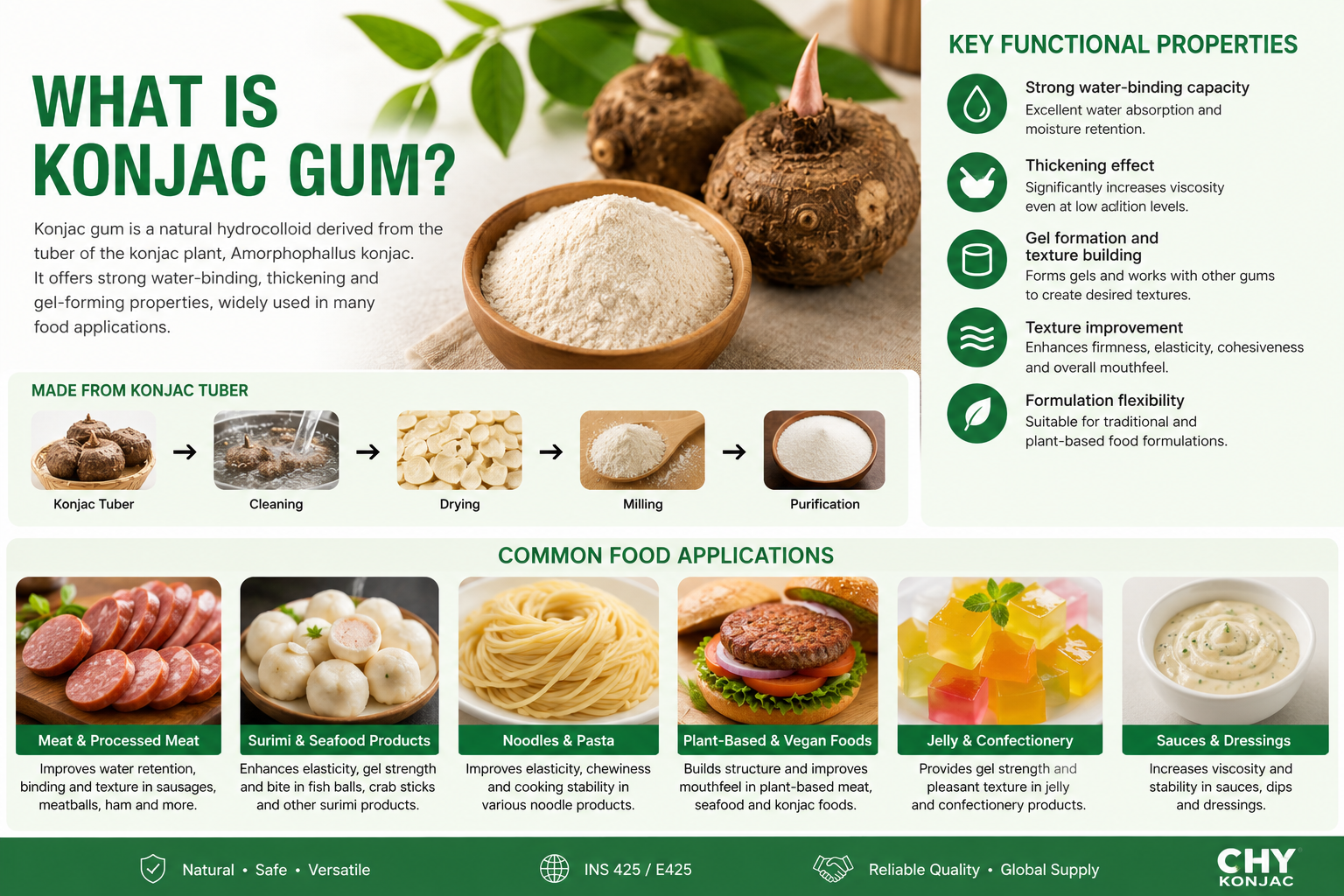
Konjac gum is a natural hydrocolloid derived from the tuber of the konjac plant, Amorphophallus konjac. Its main functional component is konjac glucomannan, a high-molecular-weight polysaccharide valued for its strong water-binding, thickening and gel-forming properties.
For food manufacturers, konjac gum is not only a thickener. It can also help improve texture, moisture retention, elasticity, mouthfeel and product stability when used in the right formulation.
Because of these functions, konjac gum is widely used in processed meat products, surimi products, noodles, jelly systems, plant-based foods, sauces, prepared foods and other food applications.
At CHY Konjac, we supply konjac gum and konjac powder for food manufacturers, importers and distributors who need stable quality, practical application support and reliable export service.
Article Overview
What Is Konjac Gum Made From?
Konjac gum is produced from konjac tubers after cleaning, drying, milling and purification. Different processing methods can produce konjac flour, refined konjac powder, konjac gum or konjac glucomannan products with different purity levels, viscosity, particle size and application performance.
In international food additive systems, konjac gum, konjac glucomannan and certain konjac flour products used as food additives are commonly associated with INS 425 or E425. However, regulations, permitted applications and dosage limits may differ between countries and product categories. Food manufacturers should always confirm local regulatory requirements before using konjac gum in commercial production.
Key Functional Properties of Konjac Gum
Strong Water-Binding Capacity
Konjac gum has excellent water absorption ability. After hydration, it can form a highly viscous system and help retain water in suitable food formulations.
Thickening Effect
Even at relatively low addition levels, the right grade of konjac gum can significantly increase viscosity.
Gel Formation and Texture Building
Konjac gum can form gels under specific processing conditions. It can also work together with other hydrocolloids such as carrageenan, xanthan gum or other stabilizers.
Texture Improvement
Depending on the application, konjac gum may help create a firmer, smoother, more elastic or more cohesive texture.
Formulation Flexibility
Konjac gum can be used in both traditional food products and plant-based formulations. The correct grade should be selected according to the target texture and process.
Not Only Price
Buyers should not select konjac gum only by price. Viscosity, purity, particle size, hydration behavior and batch consistency are also important.
Common Food Applications of Konjac Gum
Meat and Processed Meat Products
Konjac gum can be used in sausages, meatballs, ham, luncheon meat and other processed meat systems to support water retention, binding and texture improvement.
Surimi and Seafood Products
Konjac gum may be used in fish balls, crab sticks, seafood balls and other surimi-based products to help improve elasticity, gel strength and bite.
Noodles and Pasta Products
In noodle and pasta applications, konjac gum may help improve elasticity, chewiness and cooking stability.
Plant-Based and Vegan Foods
Konjac gum is suitable for many plant-based food concepts because it comes from a plant source and provides useful texture-building functions.
Jelly, Pudding and Gelled Foods
Konjac gum can be used in gelled food systems, especially when combined with other hydrocolloids.
Sauces, Fillings and Prepared Foods
Konjac gum can provide viscosity, suspension and texture stability in suitable sauce, filling and prepared-food systems.
Meat and Processed Meat Products
In these products, konjac gum performance is closely related to the full formulation, including meat protein, salt, phosphate, fat level, starch, carrageenan and processing temperature.
For manufacturers, the key question is not simply “how much konjac gum should be added,” but whether the complete formulation can achieve the desired texture, yield and cost control.
Surimi and Seafood Products
Its performance depends on surimi quality, salt extraction, chopping temperature, starch level, heating process and other stabilizers.
For factories producing fish balls or seafood analogues, konjac gum is often evaluated together with carrageenan, starch and moisture-retention systems.
Noodles and Pasta Products
Proper dispersion is very important. If hydrocolloid powders are added directly into water without pre-blending or sufficient agitation, lumps can form easily.
For industrial production, konjac gum should be tested under the actual mixing, sheeting, extrusion or cooking process used by the factory.
Plant-Based and Vegan Foods
It may be used in plant-based meat, vegetarian seafood alternatives, konjac-based foods and other vegan formulations where structure, firmness or juicy mouthfeel is required.
Final vegan or clean-label claims should be evaluated based on the full formulation, not only the konjac gum itself.
Jelly, Pudding and Gelled Foods
In jelly or pudding applications, konjac gum is usually part of a complete stabilizer system rather than the only ingredient. The final texture depends on the balance between konjac gum, carrageenan, gellan gum, salts, sugar, acid and processing conditions.
For this reason, many manufacturers prefer to use a ready-to-apply compound jelly powder or pudding powder system instead of formulating from single gums.
Sauces, Fillings and Prepared Foods
Before commercial use, stability should be tested under the product’s real pH, salt level, heating process, cooling process and shelf-life conditions.
How Much Konjac Gum Should Be Used?
There is no universal dosage suitable for every food product.
The correct addition level depends on:
- Product category
- Konjac gum viscosity
- Particle size and hydration speed
- Water content
- Target texture
- pH value
- Salt and mineral content
- Heating and cooling conditions
- Mixing equipment
- Other gums, starches, proteins and emulsifiers
As a practical starting point, food manufacturers should begin with small laboratory tests and then confirm the formulation through pilot-scale production.
CHY Konjac can recommend a suitable starting trial range after reviewing your product type, formulation, process and target texture.
To help us recommend the right grade, please provide:
- Product application
- Current formulation
- Processing steps
- Heating temperature
- Target texture
- Existing texture problem
- Required certifications
- Destination country
How to Disperse Konjac Gum Properly
Konjac gum must be dispersed correctly to prevent lump formation.
A typical procedure may include:
- Pre-blend konjac gum with sugar, starch or another dry ingredient.
- Add the dry blend slowly into moving water.
- Maintain sufficient agitation during hydration.
- Allow enough time for viscosity development.
- Adjust the process according to temperature, pH, salt and other ingredients.
- Test the final texture after heating, cooling or storage if required.
The best processing method depends on the product and production equipment. Small-scale testing is recommended before commercial production.
Typical Product Specifications
The following table should be confirmed according to the actual grade, Technical Data Sheet and Certificate of Analysis.
| Item | Specification |
|---|---|
| Product name | Konjac Gum |
| Appearance | White, granular, with a very small amount of light-yellow particles; no caking, no mold; with a very slight inherent fishy odor of konjac and a slight alcohol odor. |
| Viscosity | 32000–50000 mPa.s |
| Glucomannan content | 85%–95% |
| Moisture | <10% |
| Particle size | 60–200 mesh |
| pH | 5–7 |
| Packaging | The packaging can be arranged according to your requirements. Our standard packaging is usually paper-plastic composite bags. |
| Shelf life | 18 months |
| Certifications | Halal / ISO / HACCP |
Konjac Gum vs Xanthan Gum
Konjac gum and xanthan gum are both hydrocolloids, but they do not perform in the same way.
| Property | Konjac Gum | Xanthan Gum |
|---|---|---|
| Main function | Thickening, water binding, gel formation and texture building | Thickening, suspension and viscosity control |
| Texture | Can create elastic, firm or gelled textures depending on formulation | Usually creates a viscous and flowable texture |
| Hydration | Requires controlled dispersion to reduce lumping | Also requires proper dispersion, but behaves differently |
| Synergy | Can work with carrageenan, xanthan gum and other stabilizers | Commonly combined with other hydrocolloids |
| Typical selection reason | Texture, gel strength, elasticity, water retention | Viscosity, suspension, flow stability |
Konjac gum does not always replace xanthan gum on a one-to-one basis. The best choice depends on the target texture, processing conditions and ingredient declaration.
In some formulations, using konjac gum and xanthan gum together may be more effective than using either one alone.
How to Choose the Right Konjac Gum Supplier
For importers and food manufacturers, choosing a konjac gum supplier should not be based only on the lowest price.
A reliable supplier should provide:
- Stable batch-to-batch quality
- Clear viscosity and testing method
- Technical Data Sheet and COA
- Food safety and quality documentation
- Traceable raw material information
- Practical application support
- Sample availability
- Export experience
- Flexible communication
- Reliable packaging and delivery
A low price is not useful if the product performance changes from shipment to shipment.
Why Work With CHY Konjac?
CHY Konjac focuses on konjac gum, konjac powder and konjac-based food ingredient solutions for international customers.
We work closely with manufacturing partners in Sichuan, one of China’s important konjac-growing and food ingredient production regions. This allows us to respond quickly to customer requirements and support different food applications.
Our main advantages include:
- Focus on konjac-based ingredients
- Support for food manufacturers and importers
- Experience in jelly, surimi, meat and plant-based applications
- Flexible sample support
- Export documentation support
- Practical communication for formulation evaluation
- Halal / ISO / HACCP documentation support, where applicable
Whether you are developing a new product or improving an existing formulation, we can help you select a suitable konjac gum grade for testing.
Frequently Asked Questions
Is konjac gum the same as konjac flour?
Not always. The terms are sometimes used interchangeably in the market, but purity, glucomannan content, particle size, viscosity and application performance may differ. Buyers should compare specifications instead of relying only on the product name.
Is konjac gum soluble in water?
Konjac gum disperses and hydrates in water to form a viscous system. Proper dispersion is necessary to reduce lumping and achieve stable performance.
Is konjac gum suitable for vegan products?
Konjac gum is derived from a plant source and is commonly used in plant-based formulations. However, the vegan status of the final product depends on all ingredients, processing aids and production conditions.
What is E425?
E425 is the European food additive designation associated with konjac-based ingredients. Regulatory requirements and permitted applications may differ by country and product category, so manufacturers should confirm local rules before commercial use.
Can konjac gum replace xanthan gum?
Not always. Konjac gum and xanthan gum have different hydration, viscosity and texture characteristics. Replacement normally requires formulation testing.
Can konjac gum be used in meat products?
Yes, konjac gum can be evaluated in processed meat systems for water retention, binding and texture improvement. The final result depends on the full formulation and processing conditions.
Can I request a sample?
Yes. Please provide your product application, current formulation, process, target texture and destination country so that we can recommend a suitable grade for testing.
Request a Konjac Gum Sample
CHY Konjac supplies konjac gum and konjac powder for different food applications. To help us recommend the right product, please contact us with the following information:
- Product application
- Target texture or viscosity
- Current formulation
- Processing conditions
- Required certifications
- Estimated order quantity
- Destination country